How circularity can accelerate the shift away from fossil fuel generators.
Fossil fuel generators (FFGs) still prop up daily life and economic activity across many lower- and middle-income countries, especially where grids are absent, unreliable, or prone to lengthy blackouts. Their high operating and maintenance costs, low efficiency, reliance on volatile fuel markets, and negative climate and health impacts all underline the need to reduce dependence on them over time. Yet the very features that make generators popular today also make them stubbornly hard to phase out: they are available, familiar, low-cost, small and portable; they have established maintenance and second-hand markets.
There are clear environmental, health, and economic benefits to replacing fossil fuel generators with renewable energy alternatives (we will soon be publishing a blog on the scale of the FFG problem – look out for it). However, the transition results in a complex set of ‘after-lives’ for the original fossil fuel generators. For example:
- Disposal: The FFG may be completely disposed of and sent to a recycling facility or landfill.
- Repurpose: The FFG may be displaced from the setting where renewables are installed but relocated for use elsewhere. For example, if a small business installs solar panels, the business owner may take the FFG home for use in a domestic setting.
- Stacking: The FFG may continue to be used, or at least kept, alongside the renewable source to add to the generation capacity or remain as a back-up.
- Standby / residual use: The FFG is retained but infrequently used, often the case when customers lack trust in renewables.
So, what would it take to ditch generators without dumping their value by pushing end-of-life assets into landfill? ZE-Gen is investigating how circular models can repurpose and recycle FFGs, reinvesting their residual value (the estimated worth of an asset when a user has finished using it) into solar and/or storage installations.
Policy momentum for circularity is building in LMICs
Regional efforts across LMICs towards circularity are gaining momentum, reflecting a shared commitment to its benefits. Several countries are advancing circular economy policies, including Extended Producer Responsibility (EPR) frameworks, such as in:
- Nigeria, where EPR approaches are being used to strengthen waste management systems (including for electronics), signalling increased readiness for structured take-back and recycling ecosystems.
- India, where the National Resource Efficiency Policy, 2019, (NREP) promotes resource efficiency and circular-economy business models such as product-as-a-service, leasing, and shared ownership, through financial incentives including tax benefits, subsidies and low-interest loans
- Kenya, where the Sustainable Waste Management Act and EPR framework create roles and responsibilities for circular infrastructure and enforcement mechanisms.
These initiatives shift waste management responsibilities to producers and promote recycling and reuse. Meanwhile, regional efforts, such as the African Circular Economy Alliance, further support this transition by providing platforms for coordination and learning.
Investigating end-of-life interventions for fossil fuel generators
ZE-Gen is considering how to capitalise on these political shifts and is laying the foundations for a broad exploration of potential circularity interventions in LMICs, though in-depth research is needed to tailor such interventions to suit the specific geography, sector or stakeholders.
ZE-Gen seeks to actively discourage the uptake of new FFGs. In this study, we have explored the most impactful and feasible end-of-life interventions for fossil fuel generators to incentivise the transition from FFGs to solar in line with circular economy principles (Figure 1), assuming such an intervention should promote replacement rather than simply displacement of FFGs. Traditionally, circularity interventions target complete lifecycles, from raw material mining to end of life. Interventions span across a product’s lifecycle, working with mining companies or manufacturers to design with circularity in mind, as well as working with waste collectors and recycling organisations to minimise waste to landfill
Figure 1: Scope of research
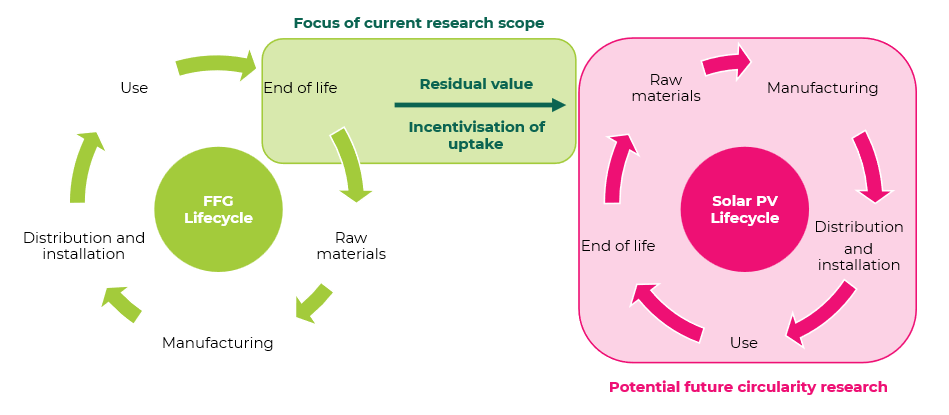
ZE-Gen has gathered case studies of circularity initiatives in industries moving away from fossil fuels to extract relevant lessons. The case studies have been grouped and structured into circularity interventions that can be applied to FFGs and then assessed against nine impact and feasibility criteria to identify the most relevant types of interventions that can support the transition to distributed renewable energy. Our study has focused on interventions that address the end-of-life of assets, capture the residual value of equipment, and incentivise the uptake of green technologies in their place.
We identified eight broad types of circularity interventions
The resulting list of intervention types is outlined in the Table 1.
Table 1: Assessed Interventions
| # | Intervention type | What it could look like |
| 1 | Awareness campaigns | Promote a public awareness campaign around the co-benefits to the end user of transitioning from FFGs to solar (e.g. health, pollution, costs etc.). |
| 2 | Low carbon design and retrofits | Enable the design and retrofit of FFGs to use alternative lower-carbon fuels like biomass. |
| 3 | Low-emission zones | Work with local/national governments in target LMICs to implement low-emission zones targeting FFG users with fines or penalties. The income generated from fines to be used to invest in community ownership of mini-grid solar systems. |
| 4 | Policy-enabled deadlines: e.g. for new FFGs sales | Encourage local and national governments in target LMICs to set deadlines for the sale of new FFGs (e.g. 2035) and design a phase-out pathway that includes investment in recycling infrastructure to avoid FFGs going to landfill, and replacement with renewables. |
| 5 | Renewables training and reskilling programmes | Support an intervention training and reskilling fossil fuel generator owners and workers for maintaining and servicing renewable alternatives like solar installations, which helps tackles a key concern of customers that support and maintenance services for solar and storage is weak. |
| 6 | Scrappage schemes | Design a scrappage scheme in target LMICs, supported by public-private partnerships between local/national governments, FFG manufacturers and solar manufacturers. (The initial phase should be short-term and timebound, with additional perks for early users, to encourage a steep uptake early on). |
| 7 | Tax | Design an FFG tax for target LMICs which can be used to fund tax exemptions for solar systems, and other perks for users (food tokens, solar-compatible clean cooking equipment e.g. stoves and fridges, discounts on air conditioning units). |
| 8 | Upcycle incentives | Donor funders to provide catalytic grants for businesses who are upcycling retired FFG materials into new, renewable energy supported products, allowing the businesses to scale pilots into viable business models. |
We evaluated the interventions for impact and feasibility
As a next step, we considered how effective (impactful and feasible) each of these interventions would be to incentivise the transition away from FFGs and towards distributed renewables.
Each intervention was assessed on:
- Feasibility: includes potential for policy support, economic viability of the intervention, as well as technical or operational feasibility.
- Impact: includes potential for environmental impact, material recovery, innovation, socioeconomic or inclusion benefits.
One of the challenges of scoring the interventions was the large geographic range. Certain assumptions and generalisations had to be made. For example, the political feasibility of implementing a jobs and skills programme would be highly dependent on the political will of the policymakers in any specific geography. We recognise that this process should be repeated in a more specific geographic, socio-economic or sectoral context to allow for context-specific differences. Figure 2 depicts the analysis based on this assessment.
Figure 2: Impact/Feasibility Prioritisation Matrix

The grant scheme (funded by philanthropies or NGOs for scaling businesses repurposing disused FFGs) had the highest possible impact score (3/3), given its potential carbon savings, the material waste material that can be recovered and the financial gains for local businesses. On feasibility, while the ZE-Gen Circularity Challenge in 2023 established the presence of relevant supply chains, there is still work to do to prove the economic feasibility and return on investment of such intervention. In addition, this type of intervention hassignificant funding requirements, as well as a clear framework for evaluating impact and capturing learnings to support broader market transformation.
The scrappage scheme scored particularly highly on technical and operational feasibility, as well as on all criteria for impact. However, this intervention requires significant coordination between the necessary stakeholders (local officials, manufacturers, scrap merchants and the public) that could pose challenges, limiting its political feasibility.
Setting a deadline for the sale of new FFGs scored highly on technical and operational feasibility, as it wouldn’t require any new technology or a particular supply chain. However, setting a deadline without simultaneously investing in recycling infrastructure may result in FFGs being dumped in landfills, which would run counter to the circularity ambitions of the intervention. While necessary, this investment could limit the intervention’s economic feasibility. In terms of impact, the intervention does not directly contribute to material recovery, but could support this through a phase-out pathway, which includes recycling of the disused generators. The impact/feasibility scores of the top-scoring interventions are shown in Figure 3 and Figure 4.
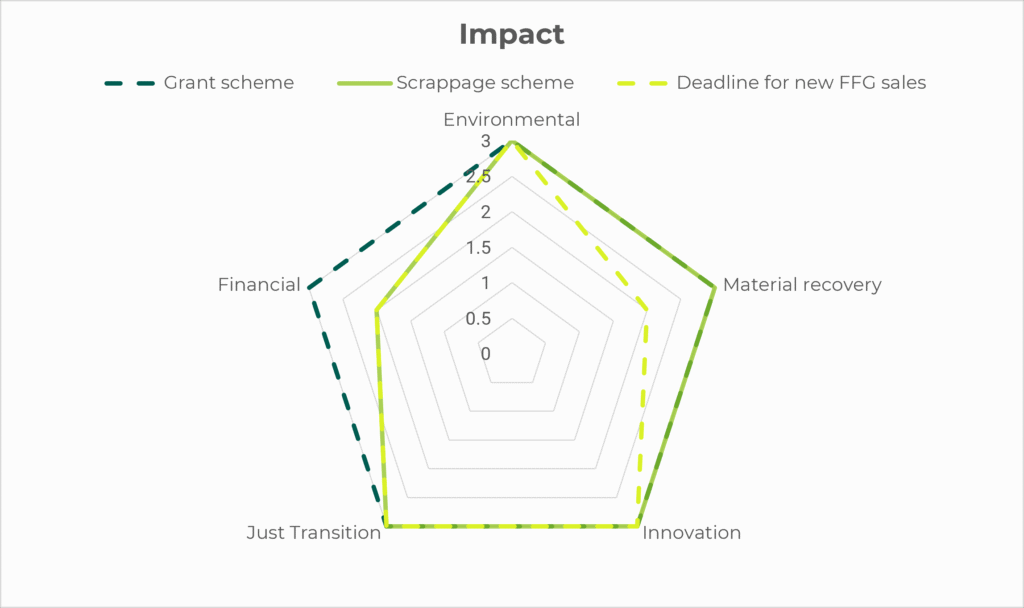
Figure 3: Impact scores for the three highest scoring interventions
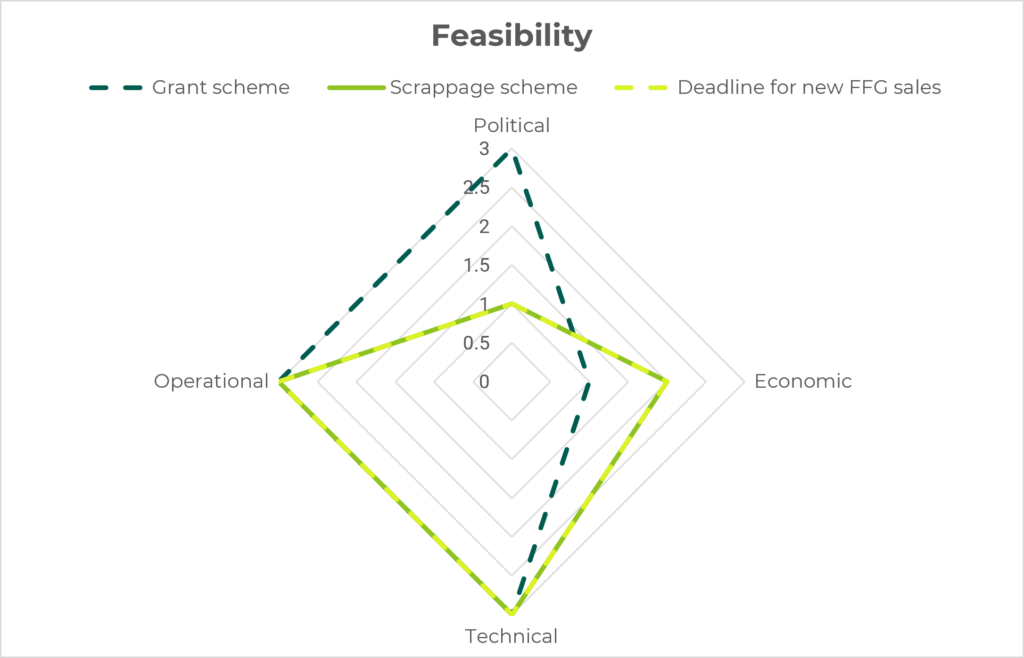
Figure 4: Feasibility scores for the three highest scoring interventions
Taking forward opportunities and exploring trades-offs between just transition outcomes
This study sets the stage with high-level intervention types that can be used to tackle the end-of-life of FFGs and the incentivisation of solar uptake. To refine these further and ensure interventions meet the country- and user- specific context, future circularity interventions could focus on:
- Assess the trade-offs between replacement, repurposing, and ‘stacking’ renewable systems with existing gensets to understand current usage patterns, consider use cases and repairability, and improve circularity outcomes over time. This would help ensure that “generator replacement” delivers measurable, credible outcomes for both energy access and climate.
- Implementing a country-specific study to deep dive into current user practices, stakeholder ecosystem, and barriers and enablers to intervention to support tailored intervention design. Ultimately, this could lead to pilots and refining high-potential interventions (like scrappage and upcycling grants), as well as strengthen the enabling environment for safe collection, verified decommissioning, and recycling ecosystems.
- Promoting design-for-recyclability for solar PV and batteries such as modular product design for easier disassembly and repair. Work with innovators to encourage designing modular, repairable solar gensets through:
- Research and development grants or innovation challenge funds for startups and companies designing modular systems
- Developing industry-wide standards for modular components
If we get generator end‑of‑life right, we don’t just retire an old technology, we help build the foundations of a cleaner, fairer energy future.
About ZE-Gen
Electricity powers progress, but globally more than 1.5 billion people still live without access to reliable energy – living without a grid connection, or suffering power blackouts for days or weeks at a time due to unreliable grid infrastructure, impacting every area of life.
Highly polluting fossil fuel generators fill this power gap across urban, rural and remote areas in Lower and Middle Income Countries (LMICs), damaging health, the environment and stopping countries meeting their economic and climate goals Launched at COP27, ZE-Gen is the leading international initiative working to improve the lives of people across Africa, South Asia and the Pacific Islands by driving the use of renewable energy in place of polluting fossil fuel generators. ZE-Gen does this through enabling new R&D, innovating financing, developing skills and growing local market appetite. The programme is supported by the IKEA Foundation and UK Aid via the Transforming Energy Access (TEA) platform.