Replacing fossil fuel generators with renewable energy alternatives requires more than new technologies. It also requires the data, evidence and confidence needed to design systems effectively, demonstrate impact and unlock investment for wider deployment.
That’s why ZE-Gen works with expert innovators and partners to identify, test and scale solutions that can accelerate the transition away from fossil fuel generation and improve the lives of people across sub-Saharan Africa, South Asia and the Indo-Pacific.
One example is the ZERO project, where ZE-Gen is working with the Access to Energy Institute (A2EI) and the Global Platform for Action on Sustainable Energy in Displacement Settings (GPA) demonstrate a new renewable energy utility model for humanitarian settings.
In this guest blog, A2EI explores how digital Monitoring, Reporting and Verification (dMRV) is helping build the evidence needed to replace diesel generators at scale and create new opportunities for investment in clean energy solutions.
WHY dMRV MATTERS FOR ENERGY ACCESS
How digital Monitoring, Reporting and Verification underpins the replacement of diesel generators with solar-plus-storage systems
Diesel generators remain the default power source across humanitarian operations, off-grid businesses and underserved communities, but they are expensive, polluting, and unreliable. Despite being commonplace, their day-to-day operation is usually poorly understood.
A2EI’s #StopGuessing approach — putting digital Monitoring, Reporting and Verification (dMRV) at the centre of every energy-access project — solves these issues by replacing assumptions with evidence at every stage: from the initial analysis of the economics of fuel generators, through system design of the solar replacement, to the ongoing proof that solar is outperforming the diesel it replaces.
1. The diesel problem — and why energy projects need proof, not guesswork
Energy access initiatives frequently operate in contexts with limited grid infrastructure and little in-house energy expertise. Diesel generators are commonly used to fill this gap as they are quick and easy to deploy. However, they often turn into a long-term liability due to volatile fuel costs, high emissions, fragile supply chains and constant maintenance. Across remote, off-grid sites in humanitarian settings, diesel-generated power typically costs USD 0.60–1.50 per kWh and every litre burned releases roughly 2.7 kg of CO₂ — most of this is avoidable with renewable energy technologies.
The deeper issue is informational, not just financial: because generators are rarely monitored, nobody knows how much energy a site consumes or when that energy is used. Often, monthly fuel bills are the only high-level source of information available to organisations on how their generators are being used. As well as having limited operational insight, without a baseline understanding of how energy is used by a facility, any renewable replacement is sized by assumption rather than evidence. This is the guesswork dMRV can eliminate.
This is why dMRV sits at the heart of every credible energy access proposal. Real, metered consumption data allows project developers to quantify current costs, diesel usage, and carbon emissions with confidence, and to translate that baseline into a fully costed business case for renewable energy. Without metered evidence of this kind, savings cannot be reliably quantified, potentially undermining project viability and reducing investor confidence.
Traditional, paper-based verification has attempted to overcome some of these issues, but the transition to digital MRV is superior in every dimension that matters to funders and project developers alike:
| Feature | Traditional MRV | Digital MRV (dMRV) |
| Data collection | Manual surveys and spreadsheets | IoT sensors and automated data |
| Time to verify | 1 to 2 years | Real-time or near-instant |
| Cost | High — requires physical auditors | Low — uses local telecoms networks |
| Accuracy | Low — prone to human error and estimation | Low — precise and tamper-proof |
| Transparency | Low — opaque methodologies | High — auditable cloud/digital logs |
2. A2EI’s metering and data backbone: Prospect
Prospect is A2EI’s open-source dMRV platform. A2EI’s technical differentiator is its ability to undertake on-the-ground metering of any kind of sites and then centralise the metered data in Prospect. This is not a one-off exercise: A2EI has developed dedicated Remote Monitoring System (RMS) deployment capability that covers every stage of the process — from procuring, installing, configuring and commissioning smart meters to remotely tracking energy consumption, generator runtime, fuel use and load profiles in real time, even in low-connectivity settings.
Prospect is the common thread running throughA2EI’s dMRV work across the energy access sector. It underpins carbon-market dMRV protocols, developed in collaboration with international standards bodies to convert metered energy data into verified carbon credits. It is also being deployed as a results-monitoring platform for development-finance institutions, automating KPI collection, and reporting for off-grid energy investments.
Every deployment draws on the same technical foundation:
- A single data platform — harmonising data from the wide array of different types of meters which are already in use across sites and partners;
- Data quality and traceability — giving A2EI’s engineering team a verifiable, auditable base for system design;
- Stakeholder-ready reporting — dashboards for site managers, headquarters, donors and implementing partners, so the same underlying information feeds into proposal-writing, design and post-installation reporting.
The data flow follows a simple, repeatable sequence in the field:
- 1. Generation — a diesel generator, solar system, or other connected asset has its energy use recorded via built-in metering or an IoT-enabled monitoring device;
- 2. Transmission — usage logs are securely sent from the site and stored on Prospect;
- 3. Calculation — algorithms automatically compute consumption, as well as cost and emissions that are avoided relative to the diesel or grid baseline;
- 4. Reporting / issuance — verified data can feed directly into funder reporting processes, performance dashboards and carbon-credit issuance.
3. From meters to megawatts: how dMRV calibrates the solar system
A core technical benefit of dMRV is precision in system design. Diesel generators are frequently oversized relative to actual energy needs and, as a result, run for long periods at low capacity — well below their optimal, most fuel-efficient operating point. Granular metering using dMRV exposes this pattern clearly, showing exactly when and how much power a site really uses throughout the day. Without this metered baseline, design choices cannot be made with confidence: the system risks being oversized, thereby wasting capital, or undersized, compromising the reliability that a site depends on.
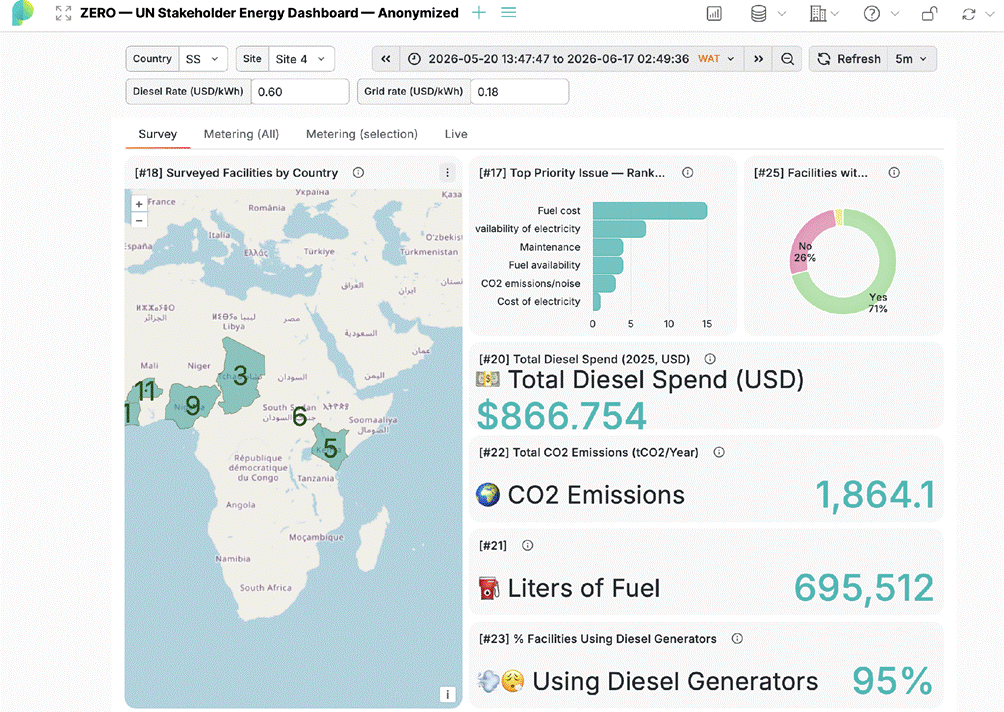
Figure 1 – Prospect dashboard aggregating energy, diesel consumption and emissions data from a selection number of humanitarian agency facilities across sub-Saharan Africa
Once a site’s actual daily and seasonal load profile is understood, rather than assumed, engineers can accurately determine the optimal size of the solar array and battery storage needed to match real demand. The resulting data can then be used to model and compare multiple solar-plus-storage configurations side by side. Rather than committing to a single unverified design, each option can be presented alongside quantified reductions in diesel consumption,the proportion of energy supplied by renewable sources, and overall cost outcomes, allowing solutions to be tailored to suit different budgets and organisational priorities.
4. After installation: dMRV as the ongoing proof point
dMRV’s role continues after the system is commissioned. Once a solar-plus-storage system is live, the same metering infrastructure continues to monitor the site — now capturing the new system’s renewable energy output, alongside any remaining generator or grid use. This turns the pre-installation baseline from a one-time projection into a live, ongoing before/after comparison, as well as providing verifiable and actionable technical insights for local teams and organisational management:
- Energy generated and consumed — solar generation, battery state and remaining diesel/grid draw, replacing the old generator-runtime logbook;
- Cost per kWh — the cost of electricity delivered, benchmarked against the previous diesel and/or grid cost, validating the savings and business case in real time;
- Carbon emitted vs. saved — continuous tracking of CO₂ avoided as diesel usage decreases, supporting carbon accounting and decarbonisation reporting for donors;
- System performance — uptime and runtime data that demonstrates service reliability against the commitments made to the facility.
This continuous monitoring closes the loop that dMRV opens at the proposal stage: the same data infrastructure that justified the investment now proves its performance, generates the evidence for the next site in the pipeline, and gives funders and partners an auditable, ongoing account of impact.
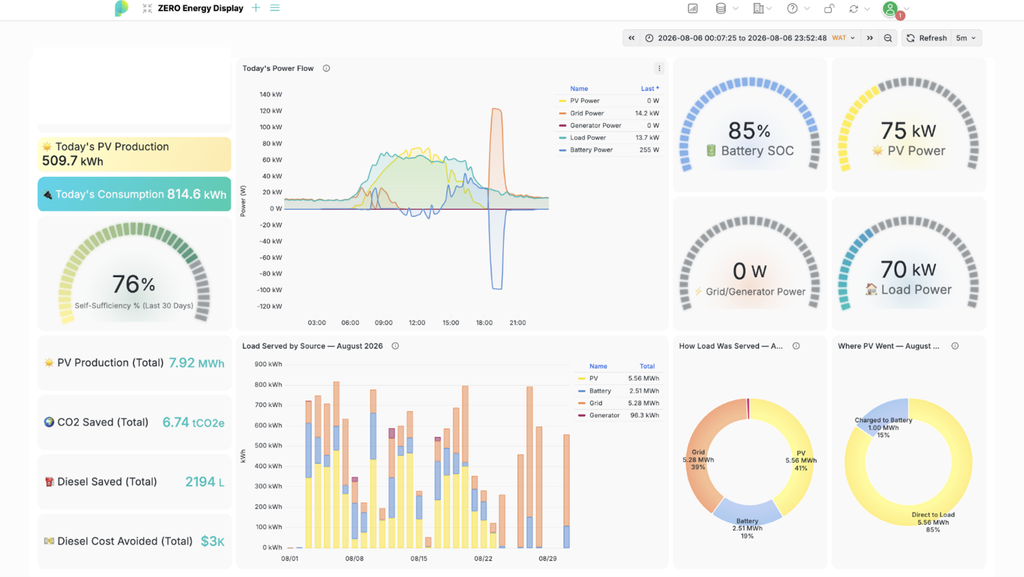
Figure 2 – Prospect dashboard showing generation data of first solar PV + battery storage installation in CHAD, as well as C02 emissions avoided and Diesel cost savings.
5. Beyond system design: dMRV as a driver of carbon finance and investment
dMRV’s relevance extends well beyond sizing and reporting a single project. By automating data collection, it also transforms how clean energy impact is proven and financed at scale — turning what used to be a slow and disparate audit process into a fast, tamper-proof digital one:
- Unlocks carbon finance — connecting distributed clean energy projects directly to global carbon markets, since carbon standards require verified digital data to issue credits;
- Reduces verification costs — automated data collection eliminates the need for expensive physical audits and manual surveys;
- Prevents fraud — connected sensors and digital logs are far harder to manipulate than paper records or manual inputs to spreadsheets, delivering tamper-proof evidence;
- Accelerates payouts — real-time or near-instant verification can shorten carbon-credit issuance periods from one to two years down to weeks;
- Attracts investors — transparent, auditable, real-time data gives ESG and impact investors the confidence to fund projects with verifiable results;
- Improves operations — continuous monitoring flags equipment issues or underperformance to technicians immediately, rather than at the next scheduled visit.
For diesel-to-solar replacement specifically, this means the same metering infrastructure that sizes the system and proves its savings can also be used to support carbon-credit issuance, thereby adding a further quantifiable revenue stream to the case for clean energy investment.
In short
dMRV is not a reporting add-on to energy-access projects — it is the mechanism that makes the entire model credible. It replaces guesswork with evidence in the funding pitch, gives engineers the technical information to size systems correctly, provides the continuous and verifiable before/after record that proves diesel-to-solar replacement delivers on its promises, and unlocks the carbon finance and investment that help such projects scale.
A three pager on specific dashboards is following soon.
Funding reference:
This project has been brought to life with funding from ZE-Gen with support from UK Aid via the Transforming Energy Access (TEA) platform.
Supported by:
