The consumer adoption gap
Fossil fuel generators (FFGs) remain a daily reality for many households and small businesses in Nigeria and Kenya. They are expensive to run, unreliable and noisy, yet consumers face significant barriers switching away from them. To support an effective market transformation, it is therefore key to understand what is stopping households and businesses to make the switch and how companies, funders and the wider ecosystem can turn interest and willingness into concrete adoption.
While many consumers understand the problems FFGs cause and are interested in renewable alternatives, this interest does not always translate into action: what we call the adoption gap.The adoption gap is shaped by a combination of practical, behavioural and market-level barriers. The most immediate constraints are practical: solar alternatives can involve high upfront costs, unclear financing options, concerns over product quality and uncertainty about after-sales maintenance. Behavioural factors also matter: generators are familiar, easy to replace in a crisis and widely reinforced through peer behaviour, making diesel feel like the safer default. Finally, adoption is also hindered by how consumers navigate the market: who they trust, what information they receive, how they compare options, and whether available offers feel credible and relevant to their needs.
Therefore, increasing adoption will require more than making renewable products available. Solutions need to address the full consumer decision journey: building trust, reducing perceived risk, improving the clarity of information, making financing easier to understand and access, and designing offers around the real behaviours of households and MSMEs.
The ZE-Gen-sponsored consumer campaigns recently closed their research and design phase. In this phase, the five projects surfaced consumer insights about what consumers need, how they perceive renewable alternatives to FFGs and what this means for programme design, market activation and consumer engagement. The projects worked directly with MSME and household consumers in Nigeria and Kenya. Read more about their findings in this short blog.
Busting the myths about renewables adoption
In surfacing consumer perceptions and attitudes towards renewable alternatives to FFGs, the studies challenged key assumptions, or myths, about the adoption gap.
Myth 1: There is a significant information gap on renewable energy products. Awareness raising is key for consumers and MSMEs.
What the projects found: Consumers and MSMEs are not starting from zero awareness. Rather, the challenge is that this awareness does not automatically translate into adoption. Across the research, many already knew about solar and recognised its potential value, but questioned whether it is a credible, reliable and low-risk alternative to the solutions they already know.
In Alimosho, consumers raised concerns around maintenance, product quality and counterfeit systems, suggesting that even interested consumers may still view solar as a risky purchase. Among MSMEs, the pattern was similar: many entrepreneurs were aware of solar, but lacked confidence that the technology, supplier or service model would reliably meet their needs. Evidence from Kenya also pointed in this direction: consumers may default to generators not because they are not aware of solar, but because generators are immediately available and socially validated.
Myth 2: Providing financing alone is enough to drive adoption.
What the projects found: High upfront cost is one of the most consistent barriers to solar adoption across the research, particularly for MSMEs. In Alimosho, upfront cost was the main barrier identified by MSMEs, while more than 70% said they would welcome support to transition, especially access to financing. This shows that finance is a critical adoption enabler and needs to be visible early in the customer journey, rather than treated as a separate step after interest has already been generated.
However, a common assumption is that providing finance will be enough to unlock adoption. The evidence suggests that this is only partly true – financing helps only if consumers can access it, understand it, trust it, and can afford it.Without this, financing may exist in theory but remain out of reach in practice.
The distinction was particularly clear in Kenya. While 62% of MSMEs cited high upfront cost, the deeper constraint was access to finance: 70% lacked collateral, 41% could not access credit, and women-led enterprises faced higher rejection rates. This suggests that affordability barriers are not only about product price, but also about how the financial system includes or excludes different customer groups. The research also shows that MSMEs may need support to become finance-ready, as financiers assess technical viability, business track record, financial health and social impact before approving loans.
Myth 3: Trust in products is built through better product information
What the projects found: While a common assumption is that trust can be built through better messaging or clearer product information, the evidence suggests this is not enough. Consumers are not only assessing whether solar works as a technology, they are also assessing the wider market around it: who is selling the product, who will install it, whether after-sales support exists, whether the supplier is legitimate, and whether other people like them have had positive experiences. In markets affected by scams, counterfeit systems and low-quality products, this makes trust a central adoption barrier. Consumers therefore need to see visible proof, credible signals and trusted guidance that help them judge quality and reduce the perceived risk of choosing the wrong product or provider.
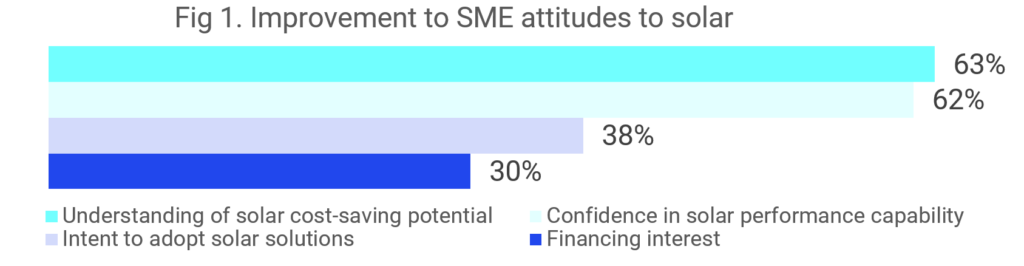
Consumer engagement in Alimosho showed that trust requires real infrastructure, including aggregated reviews, verified installers, peer validation, physical events, media recognition and government partnerships, with findings among Nigerian SMEs reinforce this point. A solar demonstrator kiosk generated various improvements in SME attitudes to solar (Fig. 1). This suggests that practical exposure can shift adoption readiness by making the technology tangible and reducing uncertainty in a way that generic awareness campaigns often cannot.
Myth 4: A main driver for adopting renewable alternatives to FFGs is the transition to clean energy
What the projects found: The research suggests that households and MSMEs are not primarily approaching solar as a climate product. They are assessing it as a practical response to unreliable power, rising fuel costs, generator dependence, business disruption and unpredictable expenses.
For households, evaluating a renewable power option involves asking whether it can replace the role currently played by a petrol or diesel generator, e.g. keep essential appliances running or protect food storage. While technical units such as kW are important product descriptors, customers often describe solutions in terms of what they power: a system that can charge phones and run lights may be useful, but for many households and MSMEs, refrigeration is the benchmark that separates a serious energy solution from a limited back-up device. The ability to power a fridge or freezer matters because it connects directly to everyday priorities: preventing food spoilage, protecting stock, supporting business activity and maintaining household resilience during outages.
On the other hand, research found that MSMEs saw solar as a way to improve reliability and reduce operating costs, with fuel and maintenance costs among the pain points customers cited most often. More than 90% of survey respondents relied primarily on petrol or diesel generators, operated them for 6 to 10 hours a day, and spent around ₦260,000 to ₦380,000 per month on fuel. For high energy intensity sectors such as ICT services, printing, refrigeration and wholesale trade, generator dependence is not a marginal inconvenience, but it represents a major operating cost and a source of daily business risk. Solar therefore becomes relevant not simply because it is cleaner, but because it can reduce exposure to volatile fuel costs, protect business continuity and reduce reliance on a system that many firms already experience as expensive and fragile.
Myth 5: Countries go through a consistent journey in their adoption of solar alternatives to FFGs
What the projects found: Nigeria and Kenya both show a consistent adoption gap, but the reasons for it slightly differ. In Nigeria, challenging market navigation emerges as the strongest recurring barrier to adoption. While demand exists, consumers face a confusing supplier landscape, unclear financing routes, concerns about product quality, and uncertainty over what system is right for their needs.
In Kenya, MSMEs are highly reactive: 70.6% passively wait during outages, and 86.2% of generator purchases are crisis-driven. In addition, motivations for the transition to alternatives was further localised: reliability in Kilifi, reputation and leadership in Nairobi, and total cost of ownership in Ruiru and Thika. Strongly localised narratives are therefore important to reach customers where they are and help resolve their biggest barriers to adoption.
What appears to work: emerging intervention models to tackle the challenges of solar genset adoption
1. Make the technology visible and tangible
One of the clearest findings of the research was that consumers need to see how solar works in practice. Where trust is low and technical understanding is limited, live demonstration can make the product feel more credible, usable and relevant. This is particularly important because consumers often do not evaluate solar through technical metrics, but through what it can power and whether it can solve a familiar problem.
As part of the ZE-Gen awareness raising research, a pilot solar demonstrator kiosk acted as a real-world proof of concept for solar performance for SMEs. The impacts of the kiosk demonstration are clear – see Fig. 1. This suggests that demonstration can shift adoption readiness by making the technology tangible. Another project implemented a roadshow pilot, which exceeded its consultation goal by 390%, suggesting that community-facing engagement can reveal latent demand when it is paired with practical support. These practical examples demonstrated that consumers can benefit from opportunities to ask questions, compare options, see products working and understand what adoption would look like in practice.
2. Building trust infrastructure rather than just trust messaging
The research suggests that trust cannot be built through communications alone. In markets where consumers are worried about counterfeit products, poor-quality systems, unreliable suppliers or unclear financing terms, interventions need to create stronger trust infrastructure around the decision.
Consumer interviews conducted during phase 1 highlighted the complexity of the journey involved in switching to solar and other zero-emission generation technologies. Prospective buyers often need to approach multiple companies to obtain quotes, distinguish credible suppliers from fraudulent operators, and navigate technical terminology alongside compliance, safety, and performance standards. At each stage, many consumers disengage as the process becomes increasingly overwhelming. One project identified a particular behavioural segment referred to as “burnt buyers”: consumers who had previously attempted to invest in solar but were sold faulty or unsuitable equipment. These negative experiences created additional barriers to adoption, making consumers more hesitant to reconsider solar or other zero-emission alternatives.
Educational tools, training platforms, and reliable, user-friendly online resources can play an important role in supporting consumers through the solar purchasing journey. By providing clear guidance on technology options, supplier selection, financing arrangements, and product quality standards, these resources can help consumers make informed decisions with confidence. In doing so, they can reduce the risk of consumers purchasing faulty or counterfeit products, while also preventing potential buyers from abandoning the process because it feels overly complex or overwhelming.
3. Treat finance-readiness as part of adoption support
Finance is a major enabler of adoption, but the research suggests that access to finance is not enough on its own. Consumers and MSMEs also need to be able to understand finance options, prepare documentation, meet lender requirements and assess whether repayments fit their cash flow.
Within this context, a ZE-Gen project identified that that many MSMEs are considered “unbankable” not necessarily because their businesses are weak, but because they rely on informal records and lack proper documentation. The project designed a curriculum to dismantle barriers to solar adoption, including modules on record-keeping and financial readiness. In a broader intervention context, solar adoption support should not only connect consumers to finance, but also prepare them to use finance. This could include basic record-keeping, explanation of payment models, support with documentation, and guidance on how lenders assess technical viability, business track record, financial health and social impact. Without this, finance may exist in the market but remain inaccessible to the consumers and businesses that need it most.
4. Segment behaviour and tailor the route to adoption
Finally, research suggested that different consumers need different routes to adoption. A single generic message is unlikely to work across households, MSMEs, high-energy users, lower-energy users and geographically distinct customer groups. The strongest interventions are likely to be those that match the message and support model to the way consumers actually make decisions. Segmentation should shape the intervention, not only the marketing message. Some consumers need proof, while others may need finance nudges, peer validation, or a clearer cost comparison. Treating all consumers as the same risks repeating the problem identified throughout the research: strong general interest, but weak conversion into adoption.
The initial design phase of the ZE-Gen awareness raising projects has provided a clear steer: interventions should focus less on broad awareness and more on conversion and adoption. Consumers already recognise many of the problems that solar can solve, but they need clearer routes to action. Effective demand-side support can therefore combine demonstration, trust infrastructure, finance-readiness and behavioural segmentation. These are not separate activities, but mutually reinforcing parts of the adoption journey.
For example, product companies and distributors can consider customer engagement as part of the core business model: consumers need clear proof of what systems can power, transparent payment options, visible examples from similar users, and confidence that installation and after-sales support will be reliable. Therefore, smaller distributors and local providers may be close to the customer, but can lack the resources to build scalable consumer pipelines, e.g. run consumer research, build demonstrations or develop financing partnerships. In addition, funders and ecosystem partners emerge as the key connective tissue of the market, coordinating providers, finance options, and community associations to remove barriers to adoption. Such institutional infrastructure can be treated as a core market building tool.
Three ZE-Gen awareness raising projects are now progressing to deployment stage. Look out for further announcements on their progress.