Replacing diesel generators with renewable energy in humanitarian settings is not simply a technology challenge, as proven solar and battery systems already exist. The harder question is how to create the commercial, financial and operational conditions that allow those solutions to be adopted and sustained at scale.
That matters because globally, humanitarian operations still rely on an estimated 11,000 diesel generators, which every year cost more than USD 100 million to run and emit around 200,000 tonnes of CO₂. The transition away from diesel has the potential to reduce emissions and operating costs, while freeing scarce humanitarian funding for priority services such as food, health, water and protection.
This is a challenge ZE-Gen is working to address. By bringing together public and philanthropic funding, evidence, innovation and partnerships, ZE-Gen is supporting solutions that can demonstrate what works in demanding humanitarian contexts and help build the foundations for wider adoption and investment.
One of those solutions is ZERO, a utility model developed by A2EI and the Global Platform for Action on Sustainable Energy in Displacement Settings (GPA), with funding from ZE-Gen through the Transforming Energy Access (TEA) platform.
Transforming Energy Access (TEA) is a research and innovation platform supporting the technologies, business models and skills needed to enable an inclusive clean energy transition. TEA is funded by the UK government.
ZERO tackles a problem that sits behind many stalled renewable-energy projects: how humanitarian organisations buy power. Rather than asking a UN agency or INGO to own and maintain a solar system or sign a long-term power agreement that may not fit its funding cycle, ZERO allows it to buy reliable, clean electricity as a service.
In our previous insight piece, A2EI explored how digital Monitoring, Reporting and Verification (dMRV) can build the evidence needed to replace diesel with confidence. Here, we look at the next part of that equation: the commercial model that could turn proven renewable technology into a scalable alternative to diesel generators.
Beyond EPC and PPAs: why a utility model suits humanitarian energy
Switching humanitarian operations from diesel to solar is rarely held back by the technology itself. More often, the barrier is how clean energy is bought, financed and maintained.
In our previous insight piece, A2EI explained how digital Monitoring, Reporting and Verification (dMRV) builds the evidence needed to replace diesel generators with confidence. In this second guest blog, A2EI turns to the commercial model: why conventional ways of delivering solar often fall short for humanitarian agencies, and how ZERO, the utility model A2EI is piloting with the Global Platform for Action on Sustainable Energy in Displacement Settings (GPA) with funding from ZE-Gen, offers an alternative.
How ZERO’s Energy-as-a-Service model removes the ownership and commitment barriers that hold back a successful solar transition for humanitarian agencies
Humanitarian operations run on diesel generators because the standard ways of delivering solar do not suit the organisations that buy the power. A2EI and GPA have built ZERO around a different question: not how to build a solar system, but how a UN agency or INGO can easily procure a more reliable, cleaner and cheaper supply of electricity.
1. Why EPC and long-term PPA models rarely work in energy access
Both standard delivery models assume a customer who can own, operate or commit to energy assets over many years. In fragile and off-grid settings that customer rarely exists, often for institutional as well as financial reasons. As a result, solar projects are either never implemented, despite making economic sense, or fail within two to three years, even though the technology is proven.
The cost of the status quo is large. At the global level, humanitarian operations run an estimated 11,000 diesel generators, at an annual cost of over USD 100 million and the emission of roughly 200,000 tonnes of CO₂ per year[i]. Cleaner solar alternatives are technically and economically viable, so the barrier is the delivery model, not the hardware.
EPC (Engineering, Procurement, Construction). The agency pays a contractor to design and build a solar system, then takes full ownership upon completion, usually with a short operations and maintenance (O&M) contract of two to four years attached. In practice this fails for four reasons:
- Upfront capital: the agency must fund the full system from budgets that fluctuate from year to year;
- Complex procurement: agencies must specify, tender and contract for technical equipment they have little in-house expertise to evaluate;
- Ownership by non-specialists: agency staff managing these sites are rarely energy specialists, and staff turnover is high. When the O&M contract ends, no one is structurally accountable for keeping the system running;
- Fuel burden remains: the agency still carries diesel procurement, fuel logistics and generator maintenance alongside the solar asset.
The typical result is a system that works at commissioning but then degrades within two to three years. The cause is not unreliable hardware but the absence of anyone responsible for operational performance.
Long-term PPAs (Power Purchase Agreements). Here a private energy provider owns and operates the system and the customer buys electricity under a contract that typically runs for many years, because lenders need long, predictable revenue streams in order to recover their capital. The model addresses ownership, but it fails for humanitarian customers on three counts:
- Contract length: Stakeholder engagement indicates that UN agencies and INGOs generally cannot commit to power purchase agreements beyond two to three years, while financiers typically require longer-term contracts;
- Expensive, risk-averse capital: energy providers financing small, unproven portfolios in high-risk contexts pay a risk premium, which is passed into the pricing tariff and erodes the customer’s savings;
- Procurement fit: agencies buy energy through internal funding lines and procurement rules built for asset purchases, and procurement teams have little incentive or know-how to switch to service contracts.
In short, EPC puts the burden of running energy assets on the party least equipped to carry it, and long-term PPAs ask that party for a commitment it cannot make. Neither offers humanitarian agencies a simple route to reliable, affordable power.
2. How the ZERO utility model is different
ZERO changes who owns, operates and carries the risk of the energy system, so the agency simply buys electricity at a per-kWh tariff, as it would from a regular utility. The solar and battery equipment is the same; what changes is the commercial structure around it. Like a PPA, the agency buys electricity rather than equipment; the difference lies in the length of commitment it is asked to make, as well as the cost of the capital behind the tariff.
| Feature | EPC | Long-term PPA | ZERO utility model (Energy-as-a-Service) |
| Who owns the system | The agency | The provider | Specialist providers; A2EI carries the financial and ownership risk |
| Upfront cost to the customer | High capital outlay | None | None |
| Contract term | Purchase plus optional O&M | Long, to repay lenders | Short-term, no long-term lock-in |
| Who runs and maintains it | The agency’s own staff | The provider | Vetted local operators, under contract |
| Who carries performance risk | The agency | Shared, depending on contract | The provider, through a 95% uptime guarantee and 24-hour response |
| What the customer pays for | The asset and its upkeep | Electricity, with a financing premium | Only the kWh consumed, at a tariff set below the diesel baseline |
Tariff built to recover capital, then drop. In two pilot projects under development in Chad, the tariff recovers the capital invested within the first two years, then falls in year three to cover only O&M costs. Recovered capital is then reinvested in additional humanitarian solar projects. Throughout, the agency is guaranteed savings of at least 25% against its baseline diesel cost, with a target of 25–50%.
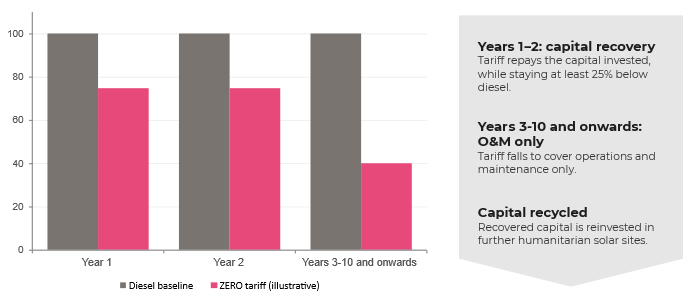
Figure 1: Illustrative energy cost to a humanitarian agency, indexed to its diesel baseline (=100)
Accountability sits with the provider. O&M is not an add-on to a purchase; it is built into the tariff and contractually owed. Local operators must meet a 95% uptime guarantee and a 24-hour on-site response time, and they carry the cost of falling short.
Operators are vetted, not assumed. ZERO contracts only local companies that have passed A2EI’s due diligence, giving A2EI direct evidence of a partner’s technical and financial reliability before it is trusted with a humanitarian site.
Patient capital replaces expensive capital. Grant funding acts as a first-loss layer for the first 10–20 sites. Once the portfolio has one to two years of repayment data, the model is designed to graduate to concessional finance, and later to commercial capital. Financial guarantees from institutions such as MIGA, UNCDF and BASE are being considered. The cost of capital falls as the evidence builds, instead of being priced in as a risk premium from day one.
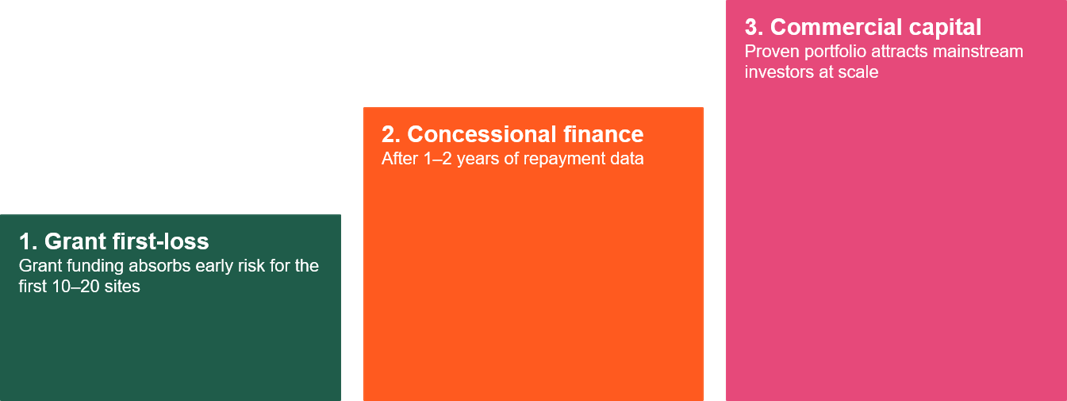
Figure 2: The ZERO capital ladder, from grant first-loss to commercial finance.
Performance is measured, not self-reported. Smart meters and inverters feed live data into Prospect, A2EI’s open-source dMRV platform (see our previous insight piece here). The same data measures uptime against the guarantee, drives automated per-kWh invoicing and builds the repayment record that lenders will need.
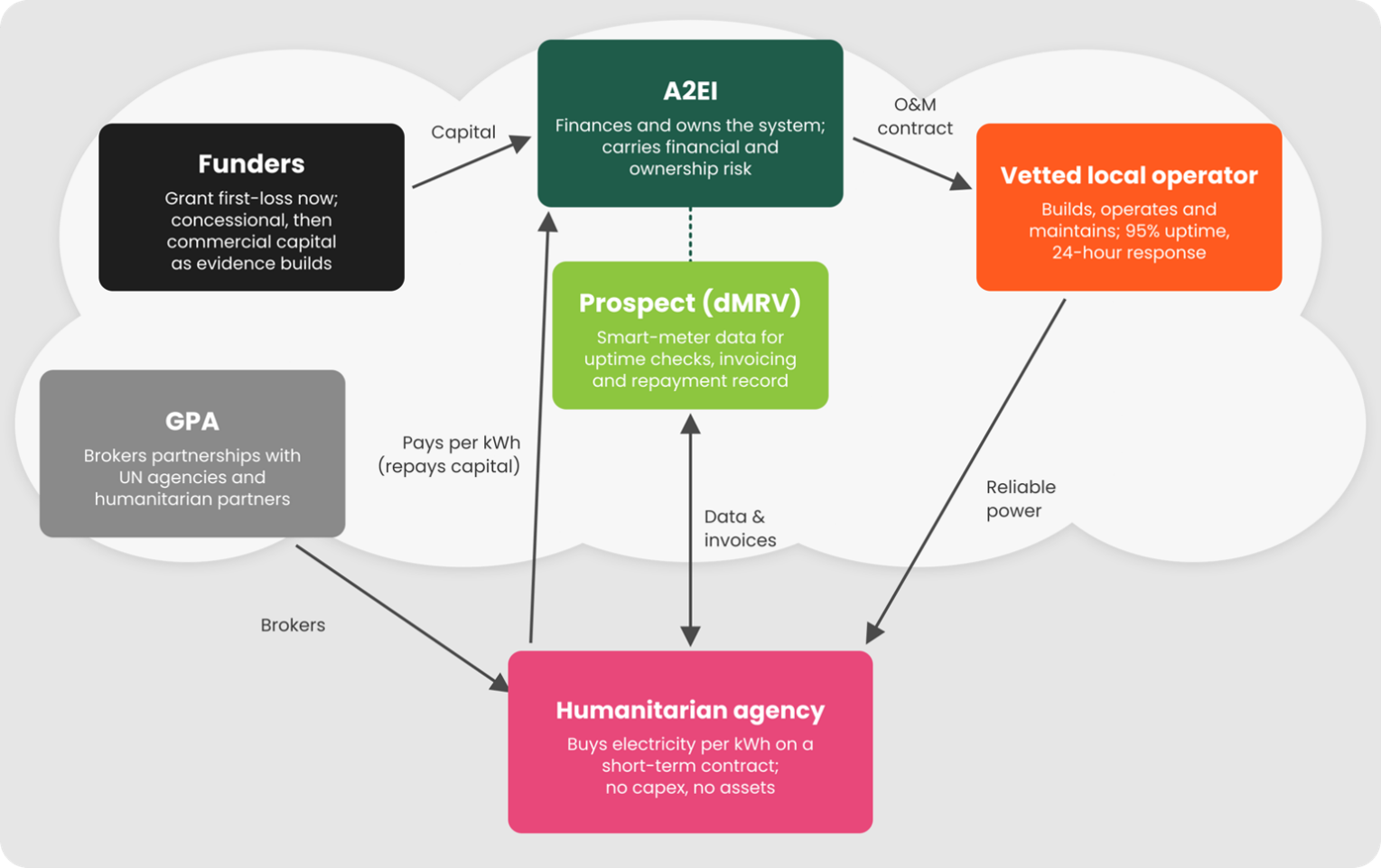
Figure 4: How the ZERO model works: who does what and how money, power and data flow
3. What customers gain, and why they prefer it
For a UN agency or INGO, the utility model offers lower energy costs from day one without the burden of owning an energy system. It asks for no capital, no technical decisions and no long-term commitment, which are the three things the other models demand.
- Immediate, measurable savings. ZERO aims to cut electricity costs by at least 25% from day one, and by 50% or more at some sites. The more remote the location, the more expensive diesel tends to be, so the savings are often greatest where operations are hardest to supply. In an era of humanitarian budget cuts, those savings go back into food, health, water and protection programmes;
- No upfront capital and no procurement of equipment. The agency does not buy, specify or tender for solar hardware. There are no design or installation decisions to make and no assets to manage;
- Reliability it can rely on. Guaranteed 95% uptime and a max. 24-hour technician response, particularly beneficial where power supports health facilities and water pumps;
- Less operational burden and risk. Performance and operational risk sit with the provider. The agency no longer handles diesel procurement, fuel transport, generator repairs or the maintenance of a solar system it was never staffed to run;
- Safer, cleaner sites and a better carbon record. Far fewer generator hours mean less exhaust, less noise and less fuel handling for staff. Metered data from Prospect also gives the agency auditable figures for diesel avoided and emissions reduced, which it can report to its own donors.
Why customers are choosing it. The model removes the barriers that have blocked solar in this sector: the agency pays only for what it consumes, and the cost is lower than diesel from the first kWh consumed. The first system, commissioned for a UN agency in N’Djamena on 31 July 2026, now gives other agencies a working example to look at. Its performance is tracked live on Prospect, with generator runtime at the site projected to fall by 73-85%. Meanwhile, a second site in eastern Chad is already in development. Scoping across Chad, Kenya, Ethiopia, South Sudan, Nigeria and Somalia has identified more than 30 priority sites, each spending around USD 100,000 a year on diesel. The evidence so far comes from two pilots and early commercial interest, and so the next phase will test whether this model scales across more sites, countries and customers.
In short
The EPC model asks humanitarian agencies to own energy assets they are not set up to run, and long-term PPAs ask for commitments they cannot make. ZERO removes both barriers: the agency buys electricity per kWh, on short-term terms and below its diesel cost, while specialist operators carry the ownership and performance risk and Prospect data tracks and proves delivery.
Funding reference:
This project has been brought to life by ZE-Gen through support from the Transforming Energy Access platform, which is funded by the UK government.

[i] GPA (2026) Fossil Fuel Powered Generators in Humanitarian Operations Produce High CO2 Emissions